Quick answer
Use ArrayList by default for most Java application code. It is compact in memory, fast for indexed reads, and efficient for the most common backend pattern: build a list, iterate it, transform it, serialize it, or return it from a service.
Use LinkedList only when you have a specific operation pattern that benefits from node-based insertion or removal, and even then, measure before treating it as faster. In real backend systems, LinkedList is often slower than expected because each node allocation adds memory overhead and pointer chasing.
Main difference
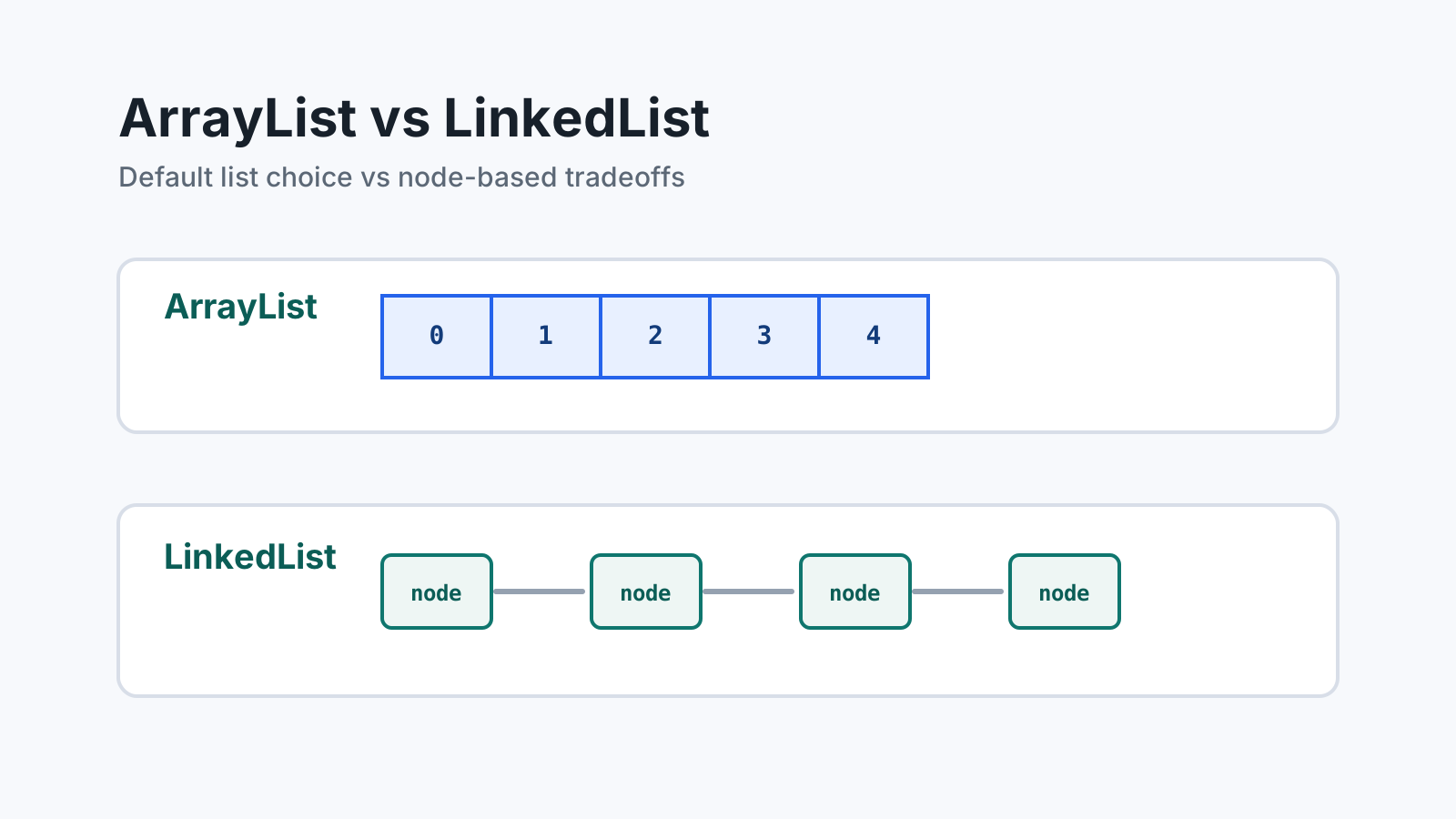
ArrayList stores elements in a resizable array. That gives it fast random access because the JVM can compute the memory position from the index. When the internal array fills up, ArrayList allocates a larger array and copies the existing references.
LinkedList stores elements in nodes. Each node holds the value plus references to the previous and next node. Once code already has a node position through an iterator, insertion and removal can be cheap. But finding an index requires walking through the list.
Performance table
| Operation | ArrayList | LinkedList |
|---|---|---|
| Get by index | O(1) | O(n) |
| Set by index | O(1) | O(n) |
| Append at end | Usually O(1), occasional resize | O(1) |
| Insert near beginning | O(n), shifts elements | O(1) after position is known |
| Remove by index | O(n), shifts elements | O(n) to find, then O(1) unlink |
| Iterate all elements | Fast and cache-friendly | More pointer chasing |
| Memory overhead | Lower | Higher |
The important phrase is after position is known. Many explanations say LinkedList insertion is O(1), but backend code often starts with an index, a value search, or a loop. In those cases, finding the position can dominate the cost.
Java example
List<String> users = new ArrayList<>();
users.add("alice");
users.add("bob");
users.add("charlie");

String second = users.get(1); // fast indexed access
This is the shape of many service-layer collections: collect records, map them, filter them, and serialize them. ArrayList fits this pattern well.
List<String> queue = new LinkedList<>();
queue.add("job-a");
queue.add("job-b");
queue.remove(0);
This code works, but if you need queue behavior, prefer a queue-oriented type such as ArrayDeque for most single-threaded use cases. The type communicates intent better and usually performs well.
Memory overhead matters
An ArrayList stores references in one backing array. A LinkedList stores a separate node object for each element, and every node has extra references for the previous and next links.
That overhead matters when a list grows large or appears in hot paths. More objects also create more work for the garbage collector. This is one reason LinkedList can lose in practice even when a simple Big-O table suggests an advantage.
Practical backend guidance
Choose ArrayList when:
- You need indexed reads.
- You mostly append and iterate.
- You return DTO lists from services or controllers.
- You process database result sets.
- You want the simplest default collection choice.
Consider another structure when:
- You need queue operations: use
ArrayDequeor aQueueimplementation. - You need priority-based removal: use
PriorityQueue. - You need thread-safe access: choose a concurrent collection or control ownership explicitly.
- You need frequent middle insertions and already hold iterator positions.
When LinkedList can still make sense
LinkedList can still be reasonable when the code truly works through an iterator and performs frequent insertions or removals near the current iterator position. That is a narrower case than many developers expect.
It can also be acceptable in small collections where clarity matters more than performance. But if the code is performance-sensitive, large, or frequently executed, measure with realistic data before choosing it over ArrayList or ArrayDeque.
Backend examples
A controller returning database rows as JSON usually benefits from ArrayList because the code appends, iterates, and serializes. A queue of jobs in one thread is usually clearer as ArrayDeque. A priority-based scheduler is usually clearer as PriorityQueue.
That is the practical lesson: choose the collection that matches the workflow, not the one that wins one isolated operation in a table.
Common mistake
The common mistake is choosing LinkedList because “insertion is faster.” That statement is incomplete. Inserting into a LinkedList is fast only when the code already has the insertion point. If the code first calls get(index), searches for a value, or walks the list, the operation is no longer simply O(1).
Related reading
Read Time Complexity of Java Collections for the broader reference table and Queue vs Deque in Java before using LinkedList as a queue. Read Java PriorityQueue Explained when you need priority-based removal. Read HashMap vs Hashtable in Java for another Java collections tradeoff, and Big-O Notation Explained for the complexity language used in this comparison. For a guided route through the cluster, open the Java Collections Learning Path.