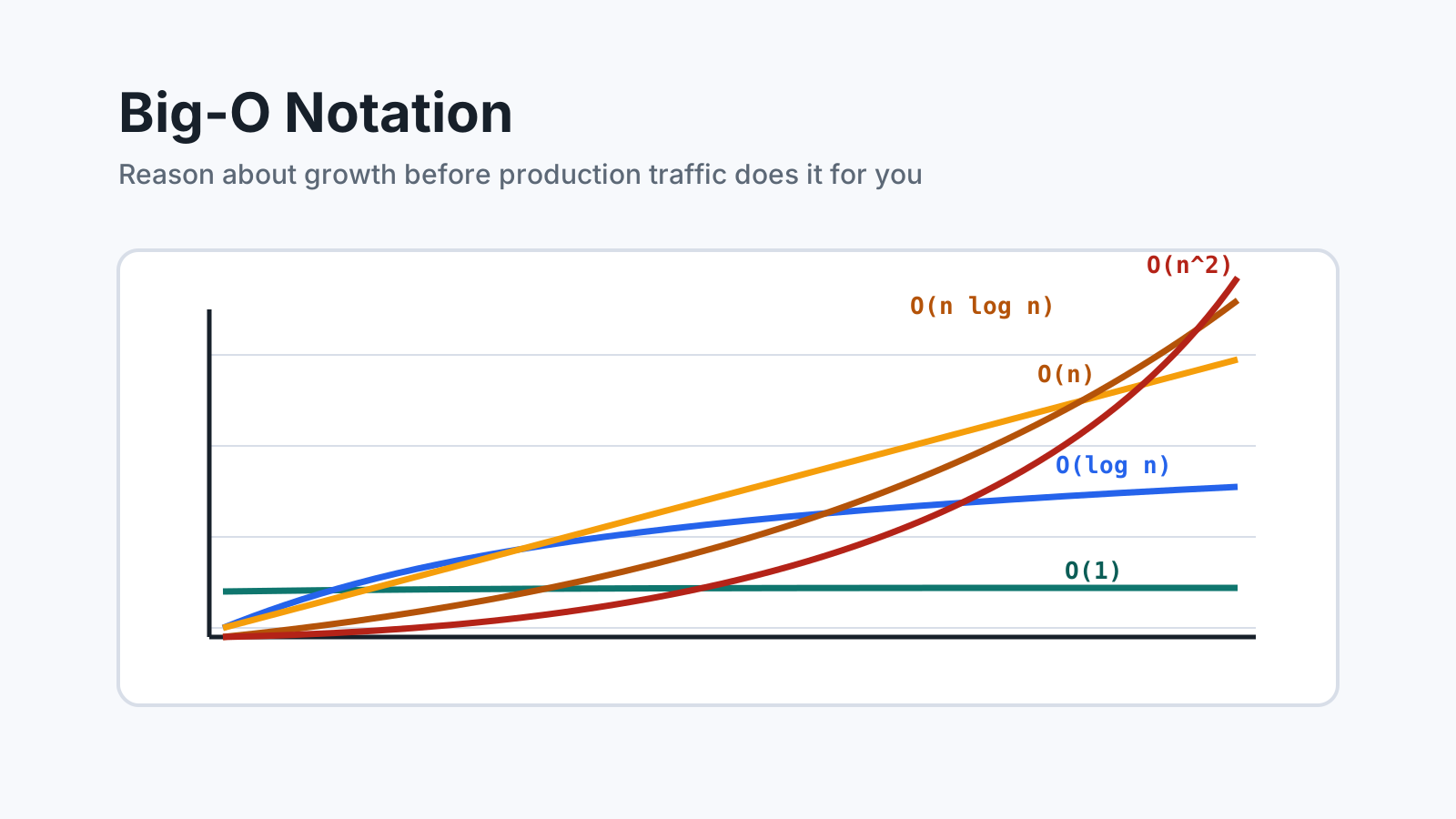
Big-O notation describes how an algorithm grows as input size grows. It is not a stopwatch. It is a way to reason about scalability before the system is under pressure.
Quick answer
Big-O tells you how work grows when input grows. O(1) stays roughly constant, O(log n) grows slowly, O(n) grows linearly, O(n log n) is common for efficient sorting, and O(n^2) can become expensive quickly.
Backend developers use Big-O when choosing data structures, reviewing loops, designing pagination, thinking about indexes, and deciding whether a slow endpoint needs caching, batching, or a different algorithm.
Why Big-O matters in backend work
A backend service can look fast with 100 rows and fail with 10 million rows. Big-O helps you ask the right question before traffic grows: does this code scan everything, compare every pair, sort too much, or repeat database work inside a loop?
It is especially useful during code review. You do not need a perfect mathematical proof for every method. You need enough complexity intuition to notice risky growth patterns early.
Constant time: O(1)
An operation is O(1) when the amount of work does not grow with input size.
Reading an array element by index is a classic example:
int value = numbers[3];A hash map lookup is usually treated as O(1) average-case, although collisions and implementation details can affect worst-case behavior.
In backend code, O(1) often appears when looking up by ID in a map, checking a set for membership, or reading a cached value by key.
Logarithmic time: O(log n)
Binary search is O(log n) because each step cuts the search space in half. Balanced trees also often provide O(log n) insertion, lookup, and deletion.
int index = Collections.binarySearch(sortedIds, targetId);For backend developers, this is the intuition behind many indexes: avoid scanning everything when a structure can narrow the search quickly.
Linear time: O(n)
An operation is O(n) when work grows in proportion to input size.
for (User user : users) {
    if (user.id().equals(targetId)) {
        return user;
    }
}
If the list doubles, the worst-case scan roughly doubles. Linear time is not always bad. Scanning 50 records in memory is usually fine. Scanning every customer on every request is not.
Linearithmic time: O(n log n)
O(n log n) often appears in efficient sorting algorithms.
users.sort(Comparator.comparing(User::createdAt));Sorting can be perfectly reasonable for a small response. It becomes risky when a backend repeatedly sorts large collections that could have been ordered by the database, precomputed, indexed, or streamed differently.
Quadratic time: O(n^2)
Nested loops are often a warning sign.
for (User a : users) {
    for (User b : users) {
        compare(a, b);
    }
}
This may be fine for 20 users and painful for 200,000. Big-O helps you notice that growth curve early.
A common improvement is to replace repeated scans with a map:
Map<String, User> usersById = new HashMap<>();
for (User user : users) {
    usersById.put(user.id(), user);
}
After that setup, repeated lookups can use the map instead of scanning the list each time.
Common complexity classes
| Complexity | Common example | Backend intuition |
|---|---|---|
O(1) | HashMap average lookup | Read by key without scanning. |
O(log n) | Binary search, balanced tree lookup | Narrow the search space quickly. |
O(n) | Loop over a list | Work grows with rows/items. |
O(n log n) | Efficient sorting | Often acceptable, but watch large repeated sorts. |
O(n^2) | Nested pair comparison | Can explode as data grows. |
Big-O and databases
Big-O is not only for interview puzzles. A missing database index can turn a query into a scan. Offset pagination can force the database to skip more rows as the page number grows. A loop that issues one query per item can create an N+1 query problem.
The exact database query planner is more complex than a simple Big-O table, but the mental model still helps: avoid repeated work, avoid scanning more than necessary, and move filtering or ordering to the right layer.
Big-O and caching
Caching does not change the complexity of the underlying algorithm. It changes how often the expensive path runs.
That distinction matters. If an endpoint is slow because it does unnecessary O(n^2) work, caching may hide the problem for popular keys while leaving cold keys slow. A better algorithm may still be needed.
The practical mindset
Use Big-O to compare approaches, not to ignore real-world measurement. Constants, memory access patterns, network calls, database indexes, serialization, and caching all matter.
The best backend engineers combine complexity analysis with profiling and production evidence.
Common mistakes
The first mistake is treating Big-O as exact timing. O(n) code can beat O(log n) code for tiny inputs if the constant overhead is lower.
The second mistake is ignoring memory. A faster algorithm may allocate much more memory, which can hurt latency, garbage collection, or infrastructure cost.
The third mistake is analyzing only application code while the real cost is database work, network calls, or external APIs.
Related reading
Read Time Complexity of Java Collections for a Java-focused reference, Sliding Window Algorithm Explained, Two Pointers Algorithm Explained, and Prefix Sum Algorithm Explained for array pattern examples. Read Binary Search Explained for the classic O(log n) pattern and Top K Elements Explained for heap-based ranking problems. Use the Big-O Cheat Sheet when you need a quick lookup while reviewing code. For the full sequence, browse the Algorithms and Complexity Learning Path.